
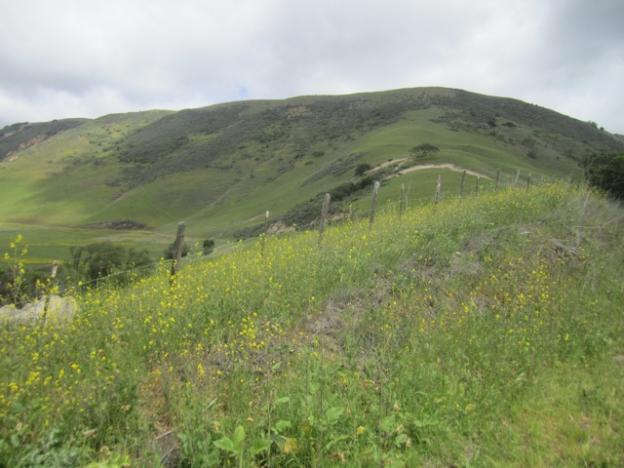
Does a Santa Cruz County Open Space District sound good to you? An exploratory campaign kicks off this spring to see if this unique conservation tool is right for our area.
by L. Clark Tate
Feb. 4, 2015—If there’s one thing we’ve all learned about California government in the seven years since the Great Recession, it’s that money for open space is not what it used to be. State Parks is strapped, counties and cities are watching their pennies, and no one is jumping up and down to buy—and then have to spend money managing—new parks.
Imagine, then, a new agency that could attract federal dollars to purchase and manage open spaces in Santa Cruz County.
Former county treasurer and current Sempervirens Fund board chairman Fred Keeley gives a sneak preview Thursday night of a proposed Santa Cruz County Open Space District, a potentially game-changing local development. He’ll also talk about the Santa Cruz Redwoods National Monument campaign. Together these two topics are huge news for Santa Cruz County’s future as a place with clean water, clean air, a healthy population and a thriving ecotourism sector.
RSVP for the Feb. 12 Santa Cruz Redwoods National Monument Campaign kickoff
The national monument has sex appeal for days, but the open space district is also, as they say, kind of a big deal. As Keeley puts it, open space districts are “a way that a community can try to realize its dreams in the area of parks, open space and conservation.” When the dreamers are a community of trompers as woodsy as ours, those are some lofty goals—globally noteworthy goals, even (come on, we’re saving redwood ecosystems here!).
Thursday’s talk, sponsored by Watsonville Wetlands Watch, is a warm-up for the official spring launch of the Open Space District information exchange.
After the launch (date TBA) Keeley, volunteering on behalf of the Santa Cruz County Board of Supervisors and the County administration, will disseminate information about—and gage interest in—launching Santa Cruz County’s very own open space district.
What Is This, How You Call It, Open Space District Anyway?
An open space district works with cities and counties in a given region to identify open space priorities, then, under the direction of an elected board, acquires land and sets usage policy. It also pays for things like trash pickup, trail maintenance, rangers and map printing.
These things, of course, cost money. An open space district establishes a source of funding—for example, Sonoma County voters approved a quarter-cent sales tax for their open space district—and uses that money to attract state and federal grants.
“What we know is that state and federal governments like to help communities that help themselves,” says Keeley.
In other words, taking this initiative demonstrates a level of financial and ideological commitment that draws allocations from state and federal funders. State and federal entities often favor communities that have established an open space district, Keeley explains, because it ensures that the benefactor doesn’t have to foot the entire bill, yet can point to a given project as an open space success.
“When you boil it down to its essence, it’s a funding source,” states Keeley.
Santa Cruz Open Space District, Redux
If this is all sounding a little familiar, that’s because the Land Trust of Santa Cruz County embarked on a similar fact finding/interest assessment process back in 2008. (Editor's Note: A correction to the year in this paragraph was made Feb. 4.)
While the abysmal economic climate of the Great Recession ultimately stymied the effort, the Land Trust preserved its efforts and findings in its Conservation Blueprint.
Now that the economy is recovering—growing, even—this report will serve as a foundation for Keeley’s research, which picks up where the Land Trust left off. “The Land Trust has done really good ground work over the years,” says Keeley, and will be “one of the key organizations to make this happen.”
The Possibilities
Neither Keeley, the county supervisors nor county administrators have a refined outcome for the exploratory process in mind. “2015 is designed to answer those,” says Keeley of his planned community engagement activities. It’s also meant to “calibrate peoples’ expectations so that it doesn’t overpromise,” he continues. “The Open Space District is not the answer to everything.”
An open space district can take many forms. Issues to consider include: 1) how it is funded; 2) where it “lives”—with county government, in the parks department or in a separate home of its own; and 3) what spaces it addresses. Will it include agricultural areas, like Sonoma County’s Agricultural Preserve and Open Space District, or focus on robust green spaces with trail systems and recreation, like the Santa Clara County Open Space Authority?
In short, there is a lot of flexibility. As Keeley puts it, “All of these open space districts are ice cream. What flavor do we want?”
He’ll be spending the year trying to figure that out. “We could have our own very special neopolitan flavor if we want.”
Watch out for announcements this spring about neighborhood and community meetings discussing the open space district.
Learn about the Thursday, Feb. 5 talk on the national monument and open space districts.
What do you think? Share your notions!
Category:


Field Notes
Plant your flag! Upload a photo, video, field note, nature poem or question for our army of (mostly) amateur naturalists.
open space district
The North Coast of Santa Cruz County has been my home since birth. I have seen it change from a quiet stretch of coast line to a busy recreation destination over the past 30 years. It used to be that there was only traffic on the best summer weekends, the beach parking spots were never full, and the only stretch of road with trash on the side was Dimeo Lane to Santa Cruz from the garbage trucks. Oh how it has changed. It will only get worse if the Sempervirens Fund and Fred Keeley get their way. I image this post will be removed/censored/never posted by the moderator of this website because it is clear from the opinions in the articles are big supporters of the aforementioned instigators for these major changes to Santa Cruz County.
As a resident of the Santa Cruz North Coast, I have been taken aback by the lack of engagement in the decision making process. Do I start by discussing the National Monument Proposal? Or do I start with The Open Space District Proposal? Perhaps I should start with the "Great Park"? I am really not sure which is the most appropriate. All I can say is that all three are part one idea that is not being discussed with the residents and communities that this "Great Park" will displace.
The Mountain Echo fall 2013 makes it very clear that the home that I was raised in, the home where I would like to raise my children is "Targeted for Acquisition." As a matter of fact my entire community is a "Target." I ask, Where is the discussion of the best forms of land management. Is it few hundred residents or thousands of tourists? There was no community engagement because the proposals are not the result of a grass roots movement by the communities of Santa Cruz county. These proposals are a vision pushed upon local residents by a private fund management company, under the auspices of environmental protection, for the purpose of turning the Northern portion of the county into a park for bay area recreation.
Every last neighbor of mine is dedicated to protection of the environment. The environment is reason that I remain in rural Santa Cruz mountains. Our land is protected though many local land use ordinances and the Coastal Commission. I enjoy these protections. If there is something that I disagree with I can bring to the floor of local elected officials. I cannot attend the closed door meetings of the Sempervirens Fund; they are not a public entity. As such, I cannot file a freedom of information act request to learn what they have planned for my home.
I am dedicated to environmental protection. However, I do not equate that with recreation. There are many examples of beautiful natural areas that are burdened with more people than they can handle. The result is more development to support more tourists... which requires more development... and so on... As an example, the East fork of the Waddell is already heavily burdened with the nutrients from the Big Basin State Park sewage treatment plant.
The Open Space District is, as stated above, "a funding source." However, it is a burden to the local county that will be taxed, to the order of 10s of millions of dollars. An Open Space District, (OPD), can be drawn so that rural (low density) areas get no voting representation. The term for the OPD board can be longer than the term for the county board of supervisors. They can levy taxes at different rates for different areas. Why does Santa Cruz County need another level of expensive bureaucracy?
In 2009, California Senator Simitian proposed an Open Space District in Santa Cruz County. In the Simitian SB 211 Senate Bill Analysis , chaired by Senator Patricia Wiggins, dated 3/26/09 it was stated, "Everything that SB211 makes possible is already within reach of Santa Cruz County’s voters and Public officials. Current law already allows the Santa Cruz Board of Supervisors to ask its voters to approve a countywide sales tax
hike to pay for acquiring and managing more open space property. Current law allows the county supervisors and county staff to run a county wide open space program, avoiding the creation of another independent special
district with its own directly–elected board of directors and separate employees. Current law requires the county government to follow the land use policies in its own general plan when buying open space property, while a separate district would set its own acquisition priorities. The committee may wish to consider whether legislators should encourage the creation of another local government when the county government already
has these powers."
If my commentary has made it out into the public, please understand that I in support of environmental conservation. I enjoy parks, hiking, mountain biking, camping, and many other forms of outdoor recreation. I also support private property rights. However, I feel that the public is given a one sided view of the issues by this website and the Sempervirens Fund website. Please research the local issues, existing protections, and what local stake holders and residents are concerned about before deciding to what to support. I believe that notion that land acquisition is the only path to environmental protection is truly outdated. When will we manage public holdings that we have instead of always saying more is better?
Sincerely,
Forest